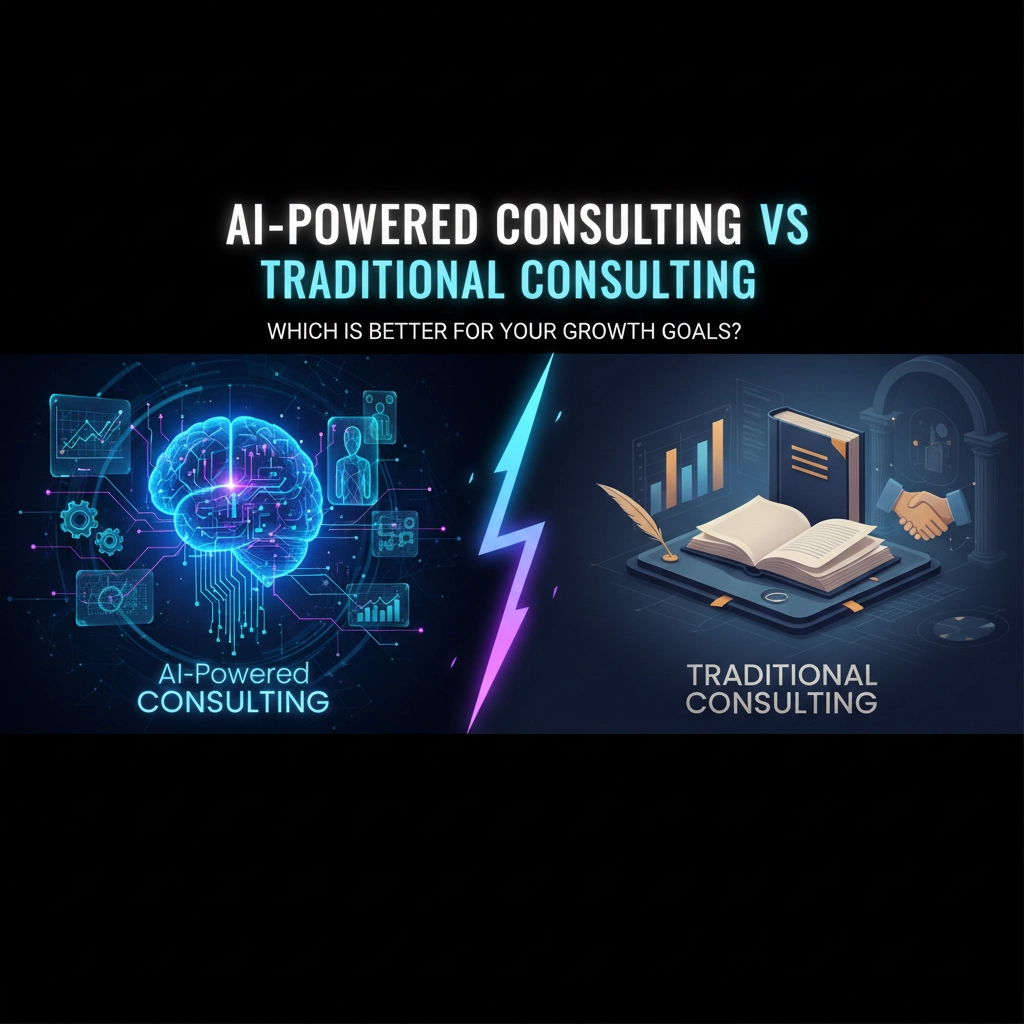
The consulting landscape is experiencing a seismic shift. While traditional consulting firms still dominate boardrooms with their polished presentations and six-figure retainers, a new breed of AI-powered consultants is quietly delivering 10X-100X growth results at a fraction of the cost.
But here's the thing: it's not about picking sides in some tech vs. human battle. Smart leaders are asking the right question: Which approach will actually move the needle on your specific growth goals?
Let's cut through the noise and break down what each approach brings to the table: and more importantly, when to use them.
The AI-Powered Consulting Revolution
AI-powered consulting isn't just traditional consulting with a chatbot slapped on top. It's a fundamentally different approach that leverages machine learning, predictive analytics, and automation to solve business problems at scale.
What Makes AI Consulting Different
Speed and Scale: While traditional consultants take weeks to analyze data and deliver insights, AI systems process information in real-time. A client recently told us their AI-powered market analysis that would have taken McKinsey 6 weeks was completed in 3 days: and it auto-updates as new data comes in.
Continuous Improvement: Traditional consulting delivers a report and walks away. AI consulting builds systems that get smarter over time. Every data point makes the recommendations more accurate, creating compound growth effects that traditional methods simply can't match.
Cost Structure Revolution: Here's where it gets interesting. While top-tier traditional consultants charge $500-1500 per hour, AI-powered consulting typically uses value-based pricing. You pay based on results: usually 10-40% of the measurable improvements generated.

The AI Consulting Sweet Spot
AI consulting absolutely dominates in three key areas:
Data-Heavy Operations: Customer segmentation, pricing optimization, demand forecasting, and supply chain management. If your growth challenge involves processing large datasets to find patterns, AI wins every time.
Scalable Systems: Building marketing automation, sales funnels, customer service workflows, and operational processes that can handle 10X growth without breaking. Traditional consulting builds processes that need more people to scale: AI builds processes that scale automatically.
Predictive Strategy: Instead of reacting to market changes, AI helps you anticipate them. Predictive customer behavior, market trend analysis, and competitive intelligence that updates continuously.
Where AI Falls Short
Let's be honest about the limitations. AI consulting struggles with:
- Complex stakeholder dynamics (office politics, change management)
- Creative strategic pivots (launching in completely new markets)
- High-touch relationship building (investor relations, partnership negotiations)
- Crisis management that requires nuanced human judgment
Traditional Consulting: The Human Advantage
Traditional consulting built its reputation for a reason. When you need someone to walk into your boardroom and command respect while navigating complex organizational dynamics, experienced human consultants are hard to beat.
Where Traditional Consulting Shines
Strategic Credibility: When you're pitching to investors or presenting to your board, having Bain or McKinsey's logo on your strategy deck opens doors. That credibility is worth paying for in high-stakes situations.
Change Management: Implementing new processes across a 500-person company isn't just about the process: it's about psychology, politics, and people management. Human consultants excel at reading the room and adapting their approach.
Creative Problem-Solving: When your industry is being disrupted or you're facing unprecedented challenges, human creativity and pattern recognition from diverse experiences across industries becomes invaluable.

The Traditional Consulting Reality Check
But let's talk about the downsides that most leaders are feeling:
Linear Scalability: Traditional consulting scales poorly. Growing from $1M to $10M revenue? You'll need 10X more consulting hours at the same hourly rate. Growing from 10 to 100 customers? Same story.
Project-Based Limitations: Traditional consulting delivers reports, not systems. Once the project ends, you're back to making decisions without their expertise. Many clients end up in recurring consulting relationships that drain cash flow.
Inconsistent Quality: Your results depend heavily on which specific consultant gets assigned to your account. The junior associate doing most of the actual work might not have the expertise you're paying partner-level rates for.
The Direct Comparison: Numbers Don't Lie
Let's get specific about what this looks like for a typical growth-stage company:
| Scenario | Traditional Consulting | AI-Powered Consulting |
|---|---|---|
| Market Analysis & Strategy | $75K-150K, 8-12 weeks | $15K-30K, 2-3 weeks |
| Customer Segmentation | $50K-100K, ongoing updates needed | $20K-40K, auto-updating system |
| Sales Process Optimization | $100K-200K, manual implementation | $30K-60K, automated optimization |
| Operational Efficiency | $150K-300K, requires ongoing management | $50K-100K, self-improving systems |
Real Example: A SaaS company we worked with was quoted $400K by a Big 4 firm for a comprehensive growth strategy and implementation over 12 months. They chose our AI-powered approach for $120K and saw 340% revenue growth in the same timeframe: while building systems that continue optimizing automatically.
Making the Right Choice for Your Growth Goals
The decision isn't about which approach is "better": it's about which aligns with your specific situation and growth trajectory.
Choose AI-Powered Consulting When:
- You have product-market fit and need to scale efficiently
- Your challenges involve data analysis or pattern recognition
- You want systems that improve over time rather than one-time solutions
- Cost efficiency is crucial for your growth trajectory
- You need speed in implementation and iteration
Choose Traditional Consulting When:
- You're pre-product-market fit and need strategic flexibility
- You're fundraising and need credibility with investors
- You're managing complex organizational change across multiple stakeholders
- You need creative strategic thinking for unprecedented challenges
- Relationship-building is central to your growth strategy
The Hybrid Approach: Best of Both Worlds
Here's what we're seeing from the smartest growth leaders: Start with traditional consulting for strategic foundation, then switch to AI for operational scaling.
This usually looks like:
- Months 1-3: Traditional consulting for strategic direction, market validation, and fundraising support ($50K-100K)
- Months 4-12: AI-powered implementation for systems building, optimization, and scaling ($40K-80K)
- Ongoing: AI systems continue improving while you maintain strategic advisor relationships
Your Next Steps
The consulting world is changing fast, and the companies that adapt quickest will capture the most growth. Here's how to evaluate your situation:
If you're ready to scale operations efficiently: Explore AI-powered consulting options. Look for providers who offer value-based pricing and can demonstrate measurable ROI within 90 days.
If you're still figuring out strategic direction: Traditional consulting might be worth the investment, but set clear milestones for transitioning to more efficient approaches.
If you want to maximize growth potential: Consider the hybrid approach. Use traditional consulting to establish credibility and strategic foundation, then leverage AI to scale efficiently.
The future belongs to companies that can combine human strategic thinking with AI-powered execution. The question isn't whether you'll make this transition: it's whether you'll make it before your competitors do.
Ready to explore how AI-powered consulting could accelerate your growth? Learn more about Scale's approach to building systems that scale automatically while you focus on strategic vision.